Reading through the Gospels #187
THE WORK OF THE HOLY SPIRIT
John 16:5-15
During the Last Supper, Jesus is teaching His disciples for the final time before his arrest and departure. Jesus tells them that He is going to the One who sent Him, and no one asks more about where He is going. I have had that happen to me. It is almost as if people hear me, but do not really try to understand what I am saying, and choose to half-listen. The disciples are just sad in their heart. They are sad because He is leaving them, but their eyes are blind to the fact that there is more to the upcoming story. It matters where we go after we leave the ones we love.
The topic at hand had been asked by Peter and answered before in John 13:36 "Simon Peter said to him, “Lord, where are you going?” Jesus answered him, “Where I am going you cannot follow me now, but you will follow afterward.”
Thomas also asked the question earlier, John 14:5-6 Thomas said to him, “Lord, we do not know where you are going. How can we know the way?” Jesus said to him, “I am the way, and the truth, and the life. No one comes to the Father except through me."
As Jesus speaks, those earlier teachings must have come to mind for the disciples.
"Nevertheless" is a transition (despite all of that) in that even though they do not inquire to know more, He is telling them the truth. (In the verse quoted above, we know that Jesus Himself is the truth! Praise Jesus for being the truth!) It is best for the disciples that Jesus go away because if He does not go away the "Helper" will not come to them. But if He does go away, Jesus will send the Helper to them. The "Helper" is the Holy Spirit, which is part of the Trinity of the Father, Son, and Holy Spirit. God the Father sent the Son, and here we see that the Son will be sending the Holy Spirit. This is a good reminder that God knows all and can see the big picture, but I do not know all and should trust Him. Sometimes parents say this same thing to their children in that they should trust them because they understand the big picture and what is best for them. There is a saying that sometimes a person cannot see the forest through the trees.
When a loved one is dying aka going away, our thoughts are often with them rather than ourselves. We think about them no longer having to suffer in this world. Here though, Jesus is thinking about us (the disciples) and that it will be better for us if He goes away aka dies on the cross to forgive the sins of the world.
In pondering more, the cool part about the Holy Spirit coming is that He is with all believers at the same time! He is omnipresent. Jesus to the disciples was seen at only 100% man and could only be with people in one place. The disciples did not realize He was 100% man and 100% God. When the Holy Spirit comes, it will be evident that God is omnipresent.
16.8 Jesus tells the disciples the purpose of the Holy Spirit when He comes in that He will convict "the world" concerning "sin and righteousness and judgment." I note the use of "the world" because the Holy Spirit convicts everyone as all have sinned and fall short of the glory of God. Every human being has a conscience that convicts them. Personally, the Holy Spirit is in my heart convicting me of my sins that I cannot make right on my own of which I am guilty and deserve the punishment of eternal death."
Jesus repeats "concerning" sin, righteousness, and judgment, so it must be really important and something He really wants the disciples to understand, with each word followed by the word "because." Sin is important especially for those who do not believe. Righteousness is important because Jesus is going to the Father and the disciples will no longer see Him. Judgment is important because the ruler of the world (Jesus) is judged (as righteous).
16:12 Jesus tells them that He has more things to say, but He is not going to say them now because the disciples cannot handle them right now. Jesus loves us! He does not put onto us the not-understood things to stress us more, but waits until the time is right. There is trust involved in letting things go because it is not the right time for us.
16:13 Jesus calls the Helper the "Spirit of truth" which is a reminder that when He convicts our hearts, it is the truth. Jesus tells the disciples that the Holy Spirit will guide them into all the truth, speaking not with his own authority, but speaking what He hears (from the Word which is God). The Holy spirit will also declare to them the things that will come. This sounds like a telling of the transition that is to happen from being with Jesus to being with the Holy Spirit. I note that He guides them, but not in every day choices because we have free will, but rather He guides us "into the truth," which has everything to do with knowing who Jesus is and what He has done for us. John 15:6, "…He will bear witness of me." The Holy Spirit is a witness to what Jesus did for us on the cross and will guide us to know that truth.
CATECHISM: The Apostles' Creed, Second Article, Part 3. What does it mean to confess that I live under Him in His kingdom? B. As our Lord, Jesus send the Holy Spirit to be with me, to teach me, and to sanctify me.
The Holy Spirit will glorify Jesus. The Holy Spirit will take what is Jesus's and declare it to us. I take this as the Holy Spirit takes the forgiveness of sins and righteousness of Jesus after His death on the cross and declares us as forgiven and righteous. Since Jesus has not died and resurrected yet, this would be difficult for the disciples to comprehend. In verse 15 Jesus explains verse 14 in that all that God the Father has is Jesus's, and therefore, the Holy Spirit will take what is Jesus's and declare it to the disciples/us. I am seeing the Trinity here because everything belongs to the Father, Son, and Holy Spirit.
YOUR SORROW WILL TURN INTO JOY
John16:16-24
September 5, 2026 Joy Challenge verses: John 16:20, 21, 22 ESV "Truly, truly, I say to you, you will weep and lament, but the world will rejoice. You will be sorrowful, but your sorrow will turn into joy. When a woman is giving birth, she has sorrow because her hour has come, but when she has delivered the baby, she no longer remembers the anguish, for joy that a human being has been born into the world. So also you have sorrow now, but I will see you again, and your hearts will rejoice, and no one will take your joy from you." (This JOY is tied to sorrow turning into JOY.)
September 20, 2026 Joy Challenge verse: John 16:24 ESV "Until now you have asked nothing in my name. Ask, and you will receive, that your joy may be full." (This JOY is tied to prayer.)
Concordance G5479 chara: χαρά, Pronounced khar-ah' (khar-ah') Meaning joy, gladness, delight, greatly joyful, from the root word G5463 (χαίρω - rejoice); Found 59 times in the Greek New Testament.
Jesus tells the disciples that in a little while they will no longer see Him, and then a little while later they will see Him. This must be so confusing to the disciples, but we know that they do not see Jesus after His death, but they do see Him again after His resurrection.
Yep, the disciples do not comprehend what He is saying because it is a little cryptic having a hidden meaning that is hard to understand. They talk to each other asking questions about what it means that Jesus is going to the Father and will be seen, unseen, and seen again. I can imagine their faces as they look at each other bewildered, "I don't get it, do you?"
I am not sure why they did not ask Jesus Himself, but He was there listening to them query each other and He knew they wanted to ask Him.
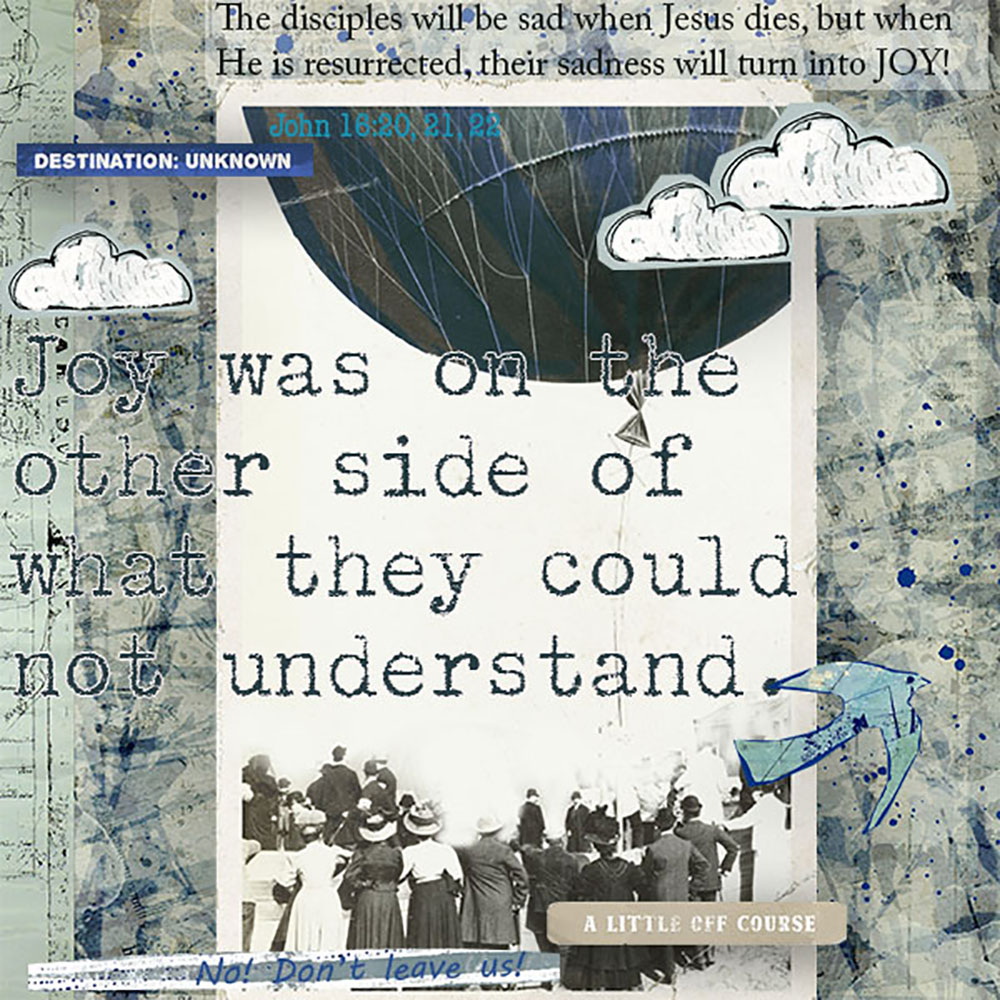
16:20 Jesus says "truly" twice which is an alert to take notice of what He says. He tells the disciples that they will weep and lament while the world rejoices. Those that love Jesus will cry because they have lost Him to death, but those who put Him to death in the world will rejoice at their success. The disciples will be sad when Jesus dies, but when He is resurrected, their sadness will turn into JOY! There current state of sadness will be no more! It is not that we will no longer have sadness in our life, but that in this instance while the disciples are mourning the loss of their friend Jesus, that state of sadness will be completely reversed in His resurrection from the dead.
16:21 Jesus shares a parable to help them understand in that a woman is in lots of sorrow (and pain) during childbirth, but after the baby is delivered, she no longer remembers the struggles during childbirth. The JOY of a human being born into the world makes the mother forget all she went through during childbirth. She is screaming in pain one minute and crying happy tears the next moment! I am sorry, not sorry, but as a female writer, I have to laugh at the fact that these male disciples have no idea what childbirth pains feel like! Okay, I'll give the analogy credit in that they probably have witnessed the light switch transition from screaming pain to JOY, so they have some experience to draw from.
16:22 Jesus tells them that this is what it will be like for them as they cry out in pain and sadness while He is gone, but when He comes back, their hearts will switch to rejoicing. I think this is a key part of this section of John 16 in that "no one will take your JOY from you." That is such a great promise to remember! This reminds me of John 10:29, "My Father, who has given them to me, is greater than all, and no one is able to snatch them out of the Father's hand." The JOY that is referenced here is the JOY of faith and no one can take my faith from me. This JOY simply originates in the resurrection promised, even while I have troubles of this world as I go through life. I emphasize the word "originate" in that JOY is not caused by anything I do, but what Jesus has done for me.
16:23 Jesus begin his next point with "in that day," and I ponder what day He is talking about. In context, "that day" would be the day of His resurrection when they realize what He has done for them and their faith begins. So for me, it would mean the day my faith began. "In that day" refers to the new era of grace starting with Christ's resurrection and ascension. Jesus tells them that they will ask nothing of Him. I think this means that because of faith, I will not feel I need anything more, so will not even think to ask for anything else. My faith is enough!
Then Jesus says the double "truly" again to make us perk up and listen to what He says next. Jesus tells them when they ask the Father for whatever, they are to ask it in His name, and the Father will give it to them. This is why when we pray, we often end our prayers, "In Jesus name I pray, Amen." This is not just some mysterious words that allow us to get whatever we want. A person’s name is linked to that person’s identity. To pray in Jesus's name means to pray consistent with who He is, and in tune with His Will and work.
CATECHISM: Ten Commandments. Second: Thou shalt not take the name of the Lord, thy God, in vain. How do we fear and love God in keeping the Second Commandment? (2) Second, we fear and love God by using His name to: A. seek from Him all good things for ourselves and others.
Also, The Lord's Prayer, Introduction, "Our Father art in heaven." How does the New Testament teach us to pray? B. prayed in Jesus' name (that is, through faith in Christ in accordance with His will) only those who believe in and pray in the name of Jesus may expect to be heard;
16:24 Jesus tells them that before now they have not asked for anything in His name. "Ask, and you will receive, that your JOY may be full." Jesus wants our JOY to be full! I ponder what He means by JOY here because I do not believe it to be happiness in worldly things, but rather the JOY in faith in Jesus that my sins are forgiven. The last part of this sentence is a caveat, that being a limiting condition that explains or cautions against a certain act. I am not to ask for just anything. I am to ask Jesus for things with the mind frame that these things will make my JOY full. Building the Kingdom of God by sharing God's Word with others and seeing them come to faith would make my JOY full.
I ponder the word full, and the first thought that comes to mind is the opposite word of "empty," and then maybe "partially full." Full suggests a unit of measurement that is complete, filled to capacity and can hold no more, satisfied, no yearning for more, whole, not cut up, and no more can get into that space.
CATECHISM: The Lord's Prayer, Introduction. How does God initiate prayer? B. promises to hear our prayers so that we can approach Him in confidence.
I HAVE OVERCOME THE WORLD
John 16:25-33
Jesus tells the disciples He realizes He is explaining what will happen in figures of speech, that being not clearly and to the point so they can understand. For instance, He has never said He is going to die, but says it as "I am going to the Father." He tells them that the hour is coming (not the day, which means the disciples know that whatever is going to happen, is going to happen that day) and thereafter He will not speak to them in figures of speech. After the disciples see what happens, He will speak plainly about the Father because then they will understand.
He tells them that "in that day," the day He dies and is resurrected, they will ask in His name. Jesus clarifies that He will not ask the Father on their behalf, because the Father himself loves them, but rather because they have loved Jesus and have believe that He came from God. We do not need to pray to Jesus to ask Him to ask God the Father, because God the Father loves us so much we can talk directly to Him. We have direct access to God the Father! We pray to God-the-whole-Trinity, God the Father, God the son Jesus, or God the Holy Spirit, because they all love us and they are all one. We pray "in Jesus name" however, because of faith, belief, and love in Jesus for what He did for us in dying on the cross to save our sins.
Jesus does state it a little more plainly in that Jesus came from the Father to live in the world, as He is 100% God and 100% man, but now Jesus the man is leaving the world to go back to the Father. I laughed out loud because in the next verse 29 the disciples agree with me that Jesus is speaking more plainly now! I read verse 29 after I wrote the first part of this note when it jumped out to me that He was speaking more plainly. I feel a need to preserve that moment of the disciples agreeing with me, so these notes stay as they are as I continue to laugh out loud.
Woah! Jesus ask them a question that I can hear Him asking every single person ever born or that will be born, "Do you now believe?" Now that Jesus spoke a tad bit more plainly, the disciples "get it" and it is as if He is asking a rhetorical question, "Do you get it and believe what is going to happen now?" It is as if He loves them so much He wants to prepare their hearts for the sorrow that will come. I reflect back on my own life and how much easier it was for my Dad to die as I had time to say goodbye with his cancer slowly taking him, but with my brother who died suddenly on a motorcycle, it was much harder on me. Jesus wants them to get it that He is going to die so their hearts can be prepared and their sorrow lessoned, or at least that is what I am seeing in this scripture.
Jesus adds to his preparation telling them that when the hour comes, they will be scattered to their own homes and leave him alone. Ouch. It is much harder to suffer a loss of a loved one when doing it together than separated. Jesus does not want them coming to the tomb looking for Him, but tells them to go home. They need to find consolation that Jesus is with the Father to get through this difficult time. The disciples do not need to worry about Jesus because He is not alone.
He tells them all of these things because He loves them and wants them to have peace through this difficult time which is about to happen. This makes me think of how my standard prayer when someone is grieving a loved one is to pray to God for peace in their hearts. The end of verse 33 is often quoted as an assurance about the end times, "In the world you will have tribulation. But take heart; I have overcome the world." In context Jesus is talking about the upcoming death and resurrection that the disciples will be going through.
CATECHISM: The Ten Commandments, Closing. Does this mean that when we live in a certain way, things will always go the way we want? No. Even Jesus, who lived a perfect life, suffered horribly. Therefore, we cling to God's promises and continue to seek to live obediently, even in the face of trouble and difficulty rather than seeking assurance of God's love and blessing in outward, visible signs and manifestations. Believers will also experience trouble, and suffering may result from their obedience.
Also, The Apostles Creed, Closing. Should I expect the Church's life to be one of continual peace and harmony? a. No. not in this life. I can expect the Church in the present age to be locked in a continual struggle with Satan as he lashes out desperately against Christ's people (Church Militant)