Reading through the Gospels #200
JESUS' RESURRECTION
Mark 16:1-8; Matthew 28:1-8; Luke 24:1-12; John 20:1-10
In all four gospels
April 9 2023, Easter: See index to the 2023 Lenten study
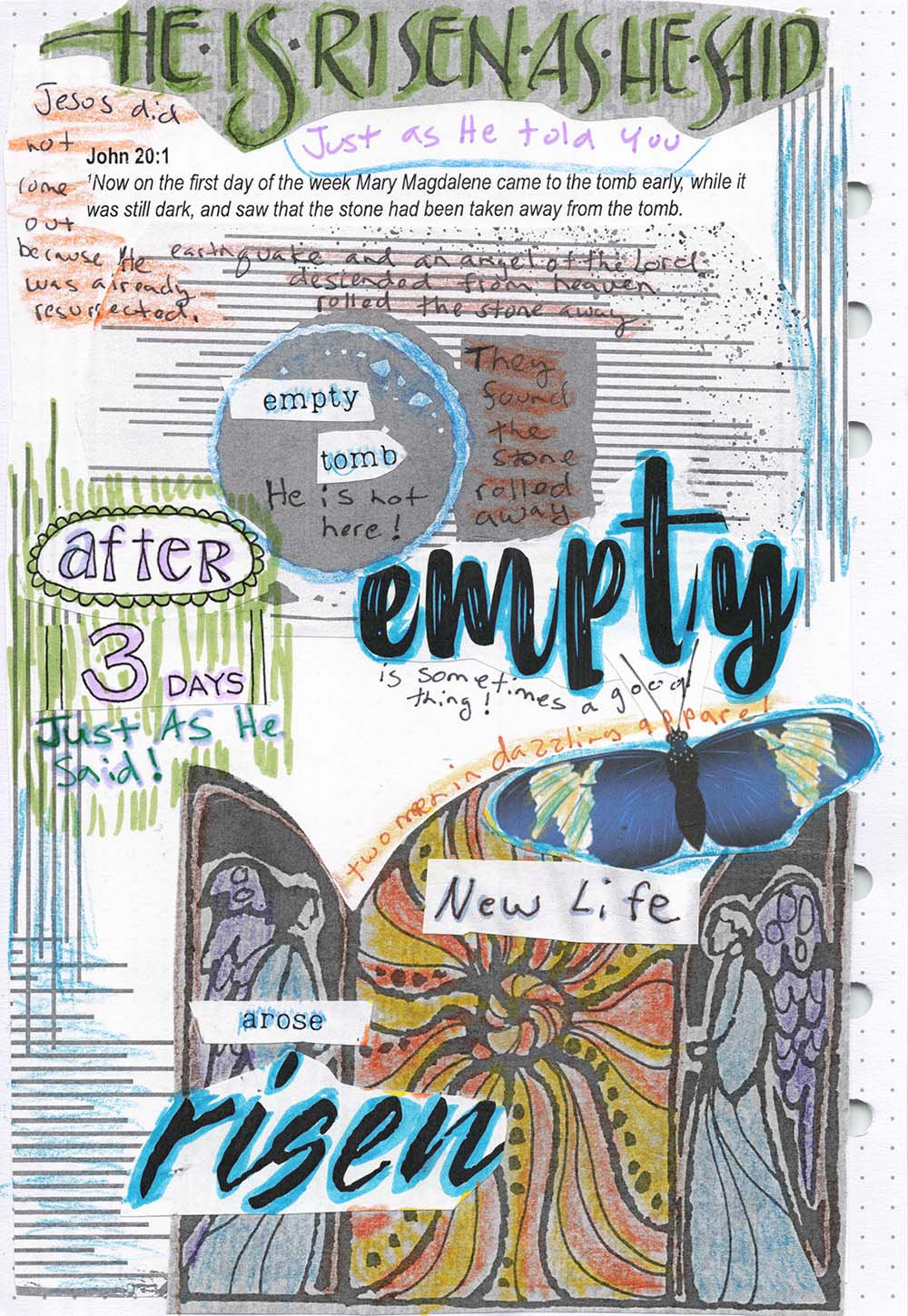
Three woman, who were also at the crucifixion of Jesus, Mary Magdalene, Mary the mother of James (and Joseph), and Salome (named in Mark) (Matthew names Mary Magdalene and the other Mary) (Luke names "they") (John names Mary Magdalene) came to the tomb. The day was after the Sabbath (Saturday) and the first day of the week (Sunday), and it was still dark (John), the sun had risen (Mark), and it was dawn (Luke). Putting them all together, I see sunrise time. This was their first opportunity as Sabbath, a day of rest, was all day on Saturday until sunset and then it was too dark to travel. They brought spices to anoint Him. Jesus was anointed many times during his life and the women were ready to anoint Him again. In Greek “the Christ,” means “anointed.” When one is anointed, they are set aside as holy for dedicated to the service of God. In this case, however, anointing was used to control the smell of decomposing. We are anointed during baptism when we receive the Holy Spirit.
Matthew 28:2 says that there was a great earthquake and an angel of the Lord, appearing like lightning in clothes white as snow, descended from heaven, rolled the stone away, and then sat on it. I laugh a bit at the image of the angel sitting down on it as if the body language says to the guards, "you think you can just fight me and put the stone back, try moving me!" I can see why the guards trembled and fell over like dead men. They probably fainted and fell to the ground unconscious. They had just felt the earth moving under their feet, seen an angel come down from the sky, and watched the angel roll the stone away and sit down on it. That would be enough to make me faint!
It would seem the women do not faint because the angel talks to them. Also, Mark, Mathew, and Luke 24:2 says that "they found" the stone rolled away, so the women were not present when the angel came down and rolled the stone away, but rather came up to it afterwards. The angel was no longer sitting on the stone, but rather He was inside the tomb.
The three were talking to each other wondering who would be there that could roll away the stone of the tomb for them when they looked up and saw that the very large stone had already been rolled away. We know from Matthew 27:65-66 that a there was a guard at the tomb. The stone was too heavy for the women to roll away and they would have been wondering if the guards would allow and help them move it away.
It is important to note that when the angel rolled the stone away, Jesus did not come out. Jesus came out when the tomb was still sealed because his body was not merely resuscitated from death like Elijah (1 Kings 17:17-24) and Lazarus (John 11:38-44). Jesus was resurrected! He IS alive! But he is not just living again, he is living again in a new body (we do not know how the body is made new). Jesus still IS arisen. That is why on Easter we often say "He IS risen" because he stays alive and risen. John 20:19 tells us that Jesus as a resurrection body could pass through material barriers. The angel rolled away the stone not for Jesus, but so that the women and whoever came up next could see that the tomb was empty and be witnesses that Jesus had arisen from the dead. Acts 2:24 says, "God raised him up, losing the pangs of death, because it was not possible for him to be held by it."
Jesus's resurrection means that I too have assurance and hope of my own resurrection some day when Jesus comes again.
1 Thessalonians 4:14 says, "For since we believe that Jesus died and rose again, even so, through Jesus, God will bring with him those who have fallen asleep."
They entered the tomb and to the right sat a young man dressed in a white robe (in Mark) (angel in Matthew) (TWO men in dazzling apparel in Luke) and they were alarmed and afraid (startled). The man said to them "Do not be alarmed (afraid). You seek Jesus of Nazareth, who was crucified. Why do you seek the living among the dead? (Luke 24:5) He has risen; he is not here. See the place where they laid him. But go, tell his disciples and Peter that he is going before you to Galilee. There you will see him, just as he told you.” Matthew 28:7 ends with "See, I have told you" which is a little different.
In Luke we read that the angel(s) reminded the women what Jesus had said and they remembered, "Remember how he told you, while he was still in Galilee, that the Son of Man must be delivered into the hands of sinful men and be crucified and on the third day rise.” Luke 18:31-33 is when Jesus first told the women what would happen after three days, “See, we are going up to Jerusalem, and everything that is written about the Son of Man by the prophets will be accomplished. For he will be delivered over to the Gentiles and will be mocked and shamefully treated and spit upon. And after flogging him, they will kill him, and on the third day he will rise.”
Angels announced the birth of Jesus (Luke 2:8-15) and angels announced the resurrection of Jesus, both times to just a few people.
The women said nothing back to the man because they were trembling and astonished (in shock), and just went out of the tomb and fled away. They said nothing because they were afraid (as in Mark) so they must have been walking silently along the road not even talking to each other because they were so shocked. I would be in shock if someone told me to go somewhere and that I would see Jesus alive and walking around. I would be in disbelief not knowing what to think. Matthew 28:8 adds that they felt fear and great joy. I have had mixed feeling before and not known how to feel. This is what they call bittersweet.
Jesus on the cross had said "My God, my God, why have you forsaken me?" and here we see that God has not forsaken Him. God the Father did not abandon Him. In His resurrection, death is conquered.
he women (Mary Magdalene, and Joanna ,and Mary the mother of James, and the other women) went to tell the 11 disciples (Luke), but the disciples did not believe what they heard instead considering it an idle tale. Peter went to go to see for himself. There were only 11 disciples because of Judas's betrayal.
John's version does not say much about the time of the women at the tomb, but goes on to say that they did run to tell the disciples and Simon Peter. In two gospels Simon Peter is mentioned separately from the other disciples and I wonder why.
According to John's gospel, Mary Magdalene ran to Simon Peter and the other disciple whom Jesus loved (John is referring to himself) to tell them. Mary Magdalene must not have believed the angel(s), or merely did not understand what they said, because she told the disciples, "They have taken the Lord out of the tomb, and we do not know where they have laid him.” She was looking for his dead body somewhere. So we see here the reason why the disciples did not believe Mary Magdalene in that she herself did not yet believe what she saw and heard. At this point, she was not a very good witness. This is why Peter and the other disciple went to the tomb to see for themselves, with the John outrunning Peter and getting there first, probably because John was younger).
John stoops over to look in to see the linens laying there. It seems like a respect for a crime scene and leaving it untouched so that he could not be blamed for anything. When Simon Peter arrives he runs right in staying true to his eager zeal nature, and John follows him. They say the tomb empty except for the linen cloths and the face cloth folded up by itself. They believed what they saw, but they did not understand how it related to Scripture and Jesus's foretold resurrection. They went home marveling at what had just seen.
12/24/25-----------------------------------------
(Matthew 28:8 ESV) So they departed quickly from the tomb with fear and great joy, and ran to tell his disciples.
How interesting that on Christmas Eve I am studying about Easter! It is fitting to reflect on the whole story of Christ from beginning to end. Jesus's birth is just the beginning, but we are blessed to know the ending as well.
Setting the scene of our study on JOY in this verse, Mary Magdalene and the other Mary arrive at Jesus's tomb at dawn. The ladies feel an earthquake and the angel of the Lord descends, rolls back the stone, and sits on it. The ladies are shocked and fearful as they witness the angel of the Lord dazzling like lightening and dressed in clothes as white as snow. The guards are terrified and frozen in fear, looking like dead men.
The angel of the Lord tells the ladies to not be afraid because the crucified Jesus has risen, just as He said He would do. The angel of the Lord invites them to look inside the tomb to see for themselves that it is empty.
The angel of the Lord tells the ladies to go quickly to tell the disciples that Jesus had risen, and that He had gone before them to Galilee. The ladies hurry away to share the good news, being filled with both fear and JOY aka STOOPID and JOY in the same instance! The ladies were filled with both emotions in the same moment!
First, I ponder the STOOPID fear which was felt due to several factors. I know I get a bit creeped-out when I visit cemeteries, so the whole mourning mood was of trembling uncertainty before the ladies even arrived. Hearts of sorrow fill their souls.
I have also experience earthquakes before and know the shocked feeling with the trembling earth under my feet. I'm imagining the ladies standing there giving each other startled looks, not yet recovered from the surprise of the shaking ground as the angel of the Lord came down. At this point the ladies are probably like the guards, frozen in fear, not even looking at each other, while the angel rolls back this heavy stone all by himself, to take a seat. The light was probably so bright from the angel's appearance that they may have been shielding their eyes with their hands while peeking out from underneath. Then to top it off, the ladies are supposed to unfreeze their feet and move to the tomb for a look-n-see.
This STOOPID feeling of fear felt by the ladies is a pure threat alert of an impending danger, unlike the "fear of the Lord" that we have today which is reverent awe. This is a terror like standing on a street corner and watching an uncontrollable vehicle coming at you. This is the kind of fear that causes a person to be unable to think or respond normally.
While still in this STUPOR of danger fear, JOY breaks through the scene and into the hearts of the ladies. I ponder the JOY which was felt due to several factors next.
First, I imagine the angel of the Lord speaking to the ladies in a calm and reassuring voice, rather than a booming voice. We do not really know, but why would he desire to scare them more? He would have wanted to calm the ladies as he tells them not to be afraid. "Yeah right," would have been my thought as my heart was still pounding out of my chest.
Then the message of hope hits their ears that Jesus has risen, just as He said He would do. I do believe this would have been the very moment when fear and JOY collided deep inside the emotions of the ladies. They must have been a wreck inside. I would call it a feeling of mingled madness! Knowing their disbelief, the angel of the Lord invites them to see for themselves.
The ladies' head must have been bewildered, "What? Jesus's body is gone! He was dead and now he is not! But where is He?" This is the turning point from fear to JOY. Their hearts feel a twinge of uplifting hope and JOY at the emptiness before them. The resurrection has now been revealed and they must quickly go spread their JOY to others.
They leave the tomb "with fear and great JOY." The JOY is growing and building up minute by minute, taking over that feeling of fear.
I can imagine the feeling of fear slowly leaving their insides as JOY wells up and takes over as they un away to tell the Good News. Fear turned into JOY and a sense of urgency to share it. Hope is revealed and JOY-gripped hearts bursts forth.
I worry about the poor guards. Did they ever unfreeze from the dead-like fear?
Please pray with me. God, thanks for this pondering that reminds me that fear and JOY do sometimes collide deep inside, and that ultimately the JOY of the gift of Your salvation always overrides fear in the end. Amen.
Concordance G5479 chara: χαρά, Pronounced khar-ah' (khar-ah') Meaning joy, gladness, delight, greatly joyful, from the root word G5463 (χαίρω - rejoice); Found 59 times in the Greek New Testament.