Reading through the Gospels #134
Luke 15:1-7 THE PARABLE OF THE LOST SHEEP
The Parable of the Lost Sheep is also told in Matthew 18:12-14. They are often considered two tellings of the same parable, but my chronological Bible separates them. Both tell of a shepherd leaving 99 sheep to find one lost sheep and God's joy over repentance. See Matthew 18:12-14 for a chart on why these two are different instances. In Luke 15 three parables are grouped together as they are about God's love for the lost and joy in saving the lost. All three are Jesus talking to Pharisees and Scribes in one continuous teaching moment.

The tax collectors and sinners are drawing near to Jesus. It is interesting how the tax collectors are separated as their own class of sinners instead of lumped together with all sinners. All sin is the same and deserves eternal death.
The Pharisees and Scribes are always following Jesus around trying to catch him in doing wrong, twisting the things Jesus does into something bad when it is anything but good. They accuse Jesus of receiving sinners and eating with them. The tradition of the Jews was to have nothing to do with those living in sin, including not sitting down to eat with them. Sinners were shunned by tradition until they were reconciled. Jesus is the opposite of that in that He welcome all sinners and makes them right Himself through His death on the cross. The Pharisees and Scribes saw sinners as someone to avoid and God sees sinners as people to restore. The Pharisees and Scribes were self-righteous and sinners are Jesus-righteous. If they do not rejoice, the problem is not with the sinner, but rather with their hearts.
To answer, Jesus told them a parable. A shepherd has 100 sheep and one is lost. Jesus asks them a rhetorical question to make them think as to whether a shepherd would leave the 99 in open country, where harm could hurt them, and goes after the lost one until he finds it. A lost sheep is never going to save itself. The Shepherd must go after it. When the shepherd finds it, he puts it on his shoulders while rejoicing. He is filled with joy that he found his lost sheep. When he gets home, the shepherd calls together his friends and neighbors to rejoice with him.
Jesus explains the parable in that it is the same as more joy found in heaven over one sinner that repents than 99 who believe they are so righteous already that they have no need to repent. God actively seeks those who are lost and heaven rejoices when even one sinner repents. Why SO much JOY over just one? No one is insignificant to God. Everyone is valuable to God. God wants everyone to be saved.
In verse 15:7, joy in Concordance G5479 chara: χαρά, Pronounced khar-ah' (khar-ah') Meaning joy, gladness, delight, greatly joyful, from the root word G5463 (χαίρω - rejoice); Found 59 times in the Greek New Testament.
Luke 15:8-10 THE PARABLE OF THE LOST COIN
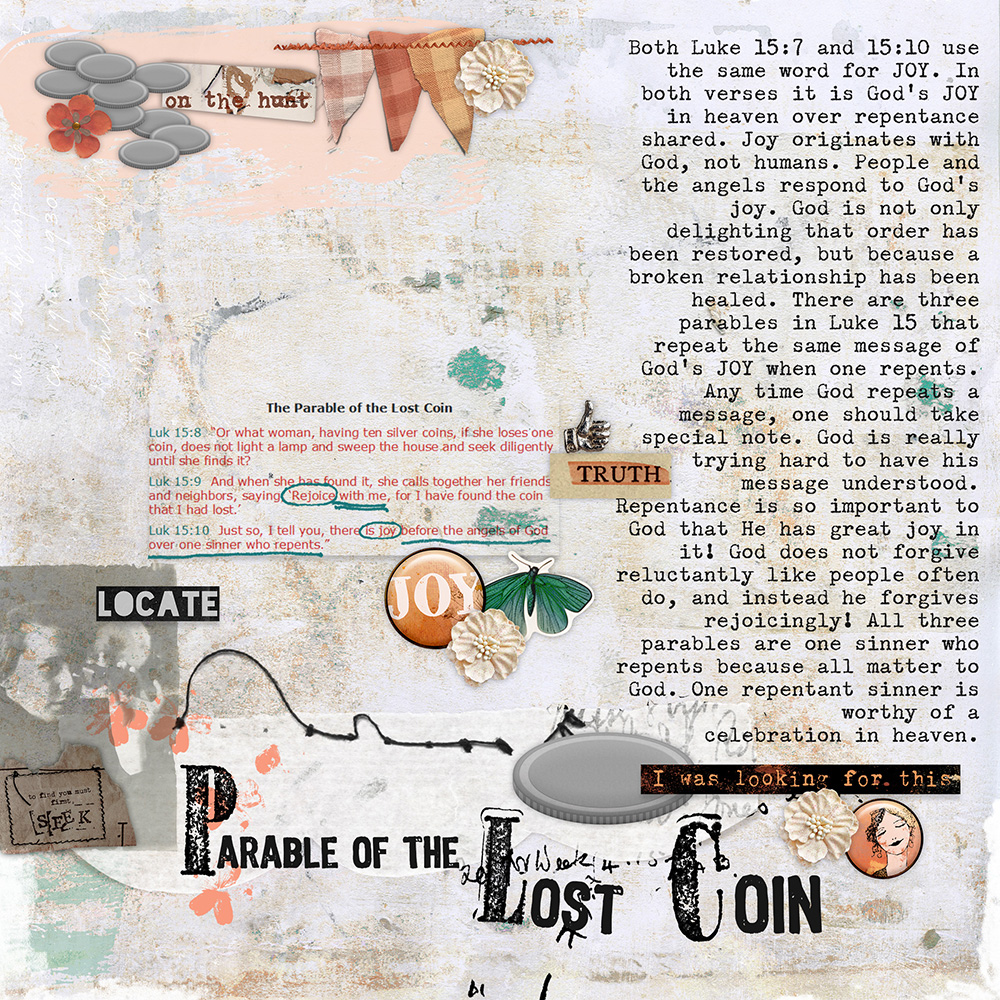
Jesus continues to answer the Pharisees and Scribes with yet another example parable. He sure wants to make certain that they understand. Jesus again asks them a rhetorical question to make them think as to whether a woman who has 10 coins, and loses 1, will light a lamp and sweep the house diligently until she finds the one lost coin. Again, just as in the sheep parable, the woman is so joyful when she finds the lost coin that she calls together her friends and neighbors to rejoice with her.
Jesus explains the parable in that it is the same as the joy before the angels of God over one sinner who repents. Every person has great value to God, and repentance brings God joy and the angels witness that joy before them (in heaven). This is an a foretaste of heaven's joy here on earth!
In verse 15:7, joy in Concordance G5479 chara: χαρά, Pronounced khar-ah' (khar-ah') Meaning joy, gladness, delight, greatly joyful, from the root word G5463 (χαίρω - rejoice); Found 59 times in the Greek New Testament.
Both Luke 15:7 and 15:10 use the same word for JOY. In both verses it is God's JOY in heaven over repentance shared. Joy originates with God, not humans. People and the angels respond to God's joy. God is not only delighting that order has been restored, but because a broken relationship has been healed. There are three parables in Luke 15 that repeat the same message of God's JOY when one repents. Any time God repeats a message, one should take special note. God is really trying hard to have his message understood. Repentance is so important to God that He has great joy in it! God does not forgive reluctantly like people often do, and instead he forgives rejoicingly! All three parables are one sinner who repents because all matter to God. One repentant sinner is worthy of a celebration in heaven.
Luke 15:11-32 THE PARABLE OF THE PRODIGAL SON
Jesus really wants the Pharisees and Scribes to understand so He tells yet another example parable of the well-known parable of the prodigal son. Many books and devotions have been written on this parable!
A man has two sons. The younger seems anxious to have his inheritance now and asks his father for his share now. The father must really love his son because he immediately divided his property between his two sons. I note that the older son had to wait longer merely because of his age for his property which speaks of patients and trust in his father.
Not many days passed before the younger took all that he owned on a long journey to a country far away and squandered away all he owned on reckless living. He sounds immature to me and just wanted to live the good and fun life instead of being responsible. Timing has it that as soon as he had no more property aka money, a famine hits and he is now in need of just the basics of food, shelter, and clothing. So now he has to go to work! Personally, I do not feel sorry for him at all. I feel like it is about time he learns his lesson the hard way. His job is to feed pigs in the field. He cannot even eat what he is feeding the pigs because he does not own that feed, and no one is offering to help him by giving him food either. This younger son is now in dire straits!
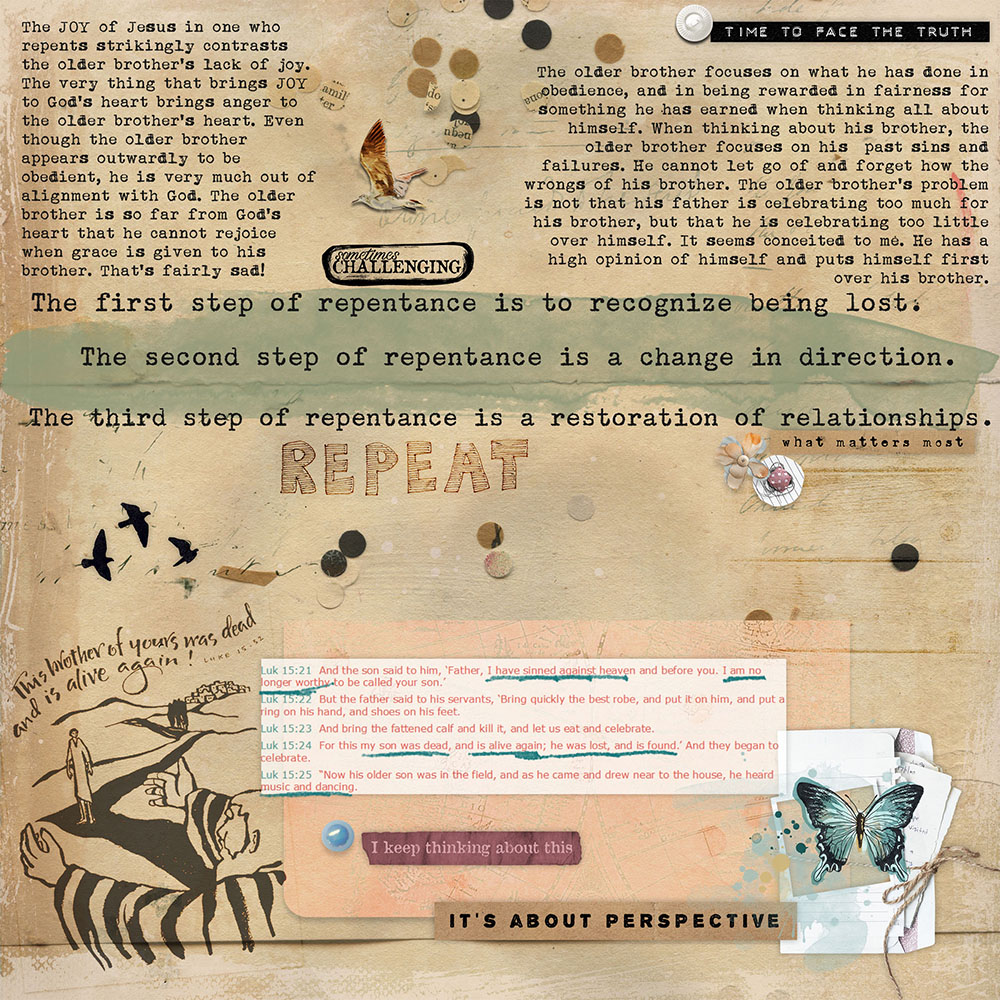
The younger son comes to a bit of a skewed senses realizing that his own father's servants have enough bread and yet he, as a son who is more valuable than a servant, has none and will eventually perish of hunger. The first step of repentance is to recognize being lost. This is like a duh-huh! moment that strikes him upside the head and into correct senses. He makes a choice to humble himself by going to his father admitting his sin against his father and heaven, declaring himself unworthy to be called a son, and asking to be treated like one of the servants. The second step of repentance is a change in direction. A person turns around.
On his way home to his father, probably anxious about admitting guilt and repenting, his father felt compassion on him and ran to meet him, embracing him with forgiveness and kissing him, all before the son could say a single word. The father knew his sons heart just by his action of return home. The father was full of love for his son to forgive him so instantly. The third step of repentance is a restoration of relationships.
After being forgiven by the father, the younger son speaks to admit his guilt and repent. The father answers him by calling for his servants to bring the best robe for his son, a ring for his finger, shoes, and to kill a fattened calf to eat and celebrate the sons return. In verse 24, the father declares, "For this my son was dead, and is alive again; he was lost, and is found." This mirrors spiritual life in that we are dead (eternal separation from God) and lost, but because of Jesus we are alive again (eternal life with God) and found. So everyone started to celebrate.
The older son, who has been faithful and good the entire time, came in from the fields and heard all of the celebrating going on. He asked one of the servants what was going on who told the older brother that his brother had been received by his father safe and sound. That quick forgiveness for his brother made him angry right away and he refused to go in to celebrate with everyone. The servant must have told the father for he came out and entreated the older son. The son expressed how he felt to the father in that he had always obeyed his father and yet his father had never celebrated his being good, yet celebrates his brother being bad. Life seems SO unfair!
The father replied to his older son that he is always with him and all that he has is his. In other words, is older son was always alive and with him and has access to use everything in the home, which mirrors the faithful in Christ always having eternal life and always being with God and always having access to the goodness of God. God is merciful and eager to forgive repentant sinners, while warning against self-righteousness and resentment toward grace. God delights in restoring the lost, offers extravagant mercy to repentant sinners, and calls the “righteous” to share His compassion rather than resent it.
The JOY of Jesus in one who repents strikingly contrasts the older brother's lack of joy. The very thing that brings JOY to God's heart brings anger to the older brother's heart. Even though the older brother appears outwardly to be obedient, he is very much out of alignment with God. The older brother is so far from God's heart that he cannot rejoice when grace is given to his brother. That's fairly sad!
The older brother focuses on what he has done in obedience, and in being rewarded in fairness for something he has earned when thinking all about himself. When thinking about his brother, the older brother focuses on his past sins and failures. He cannot let go of and forget how the wrongs of his brother. The older brother's problem is not that his father is celebrating too much for his brother, but that he is celebrating too little over himself. It seems conceited to me. He has a high opinion of himself and puts himself first over his brother.
I am reminded it is much better to share in heaven's joy than stand outside with my resentment.