Reading through the Gospels #138
Luke 17:20-18:14 (Why did the chronological order list all of these together! Now we have three stories on one page.)
Luke 17:20-37 THE COMING OF THE KINGDOM OF GOD

There is a lot of red lettering in this section of Scripture! Jesus is speaking! I should listen carefully.
The Pharisees ask Jesus when the Kingdom of God would come. Then Jesus answers the Pharisees that the Kingdom of God is not something we can observe coming, or point to as we tell others because it is not a physical thing. The Greek word for observation means "investigation," which is more like a doubter critiquing what is seen. Jesus is not coming for doubters like the Pharisees, but rather believers. I like the reference to "in the midst of you" because that phrase really describes where the Kingdom of God is now. Literally, the King Himself was right there talking to the Pharisees! The Kingdom of God was standing right in front of them and they did not recognize it. Jesus is also in my heart and with me wherever I go. Jesus came to earth once and will come again, and yet He is right here with me. He is omnipresent.
Then Jesus turns and speaks to His disciples. I wonder why he redirected his voice. It does not say that the Pharisees left. They must still be listening.
Oh, I see why! The disciples will desire to see Jesus again, but will not see Him. The Pharisees will not have that desire.
Jesus continues indicating that "they" will say they see Jesus, that being, the Pharisees and all unbelievers will say it. Be careful for those that might try to trick believers. We will know when Jesus comes again because His presence will be like flashes of lightening that light up the entire sky from one side to the other.
Then Jesus continues to tell them what will happen first before He comes again. Jesus must suffer and be rejected. I note the use of the word "must" which means Jesus's suffering was required. As it was during the days of Noah, it will be during the days Jesus is suffering. All of the evildoers were carrying on with life, enjoying it with food, drink, and marriage, before the flood destroyed them.
The same happy daily goings-on were happening in the days of Lot before he went away from Sodom and fire and sulfur destroyed them.
The same happy daily goings-on will be happening when Jesus comes again and is revealed. I ponder the word "revealed" in that Jesus slowly revealed Himself to the disciples in the Gospels, and now to us in His Word, but the revelation will happen again when Jesus comes again.
The Bible uses the words "on that day" a lot too. There is a "that day" that only Jesus knows when it will be. When Jesus comes again, He tells us to leave our worldly things behind and to not look back like Lot's wife. This is an important bit of instruction we need to remember! It feels like it will be a final test of faith. Lot's wife almost made it out safe, but then her lack of faith was her demise. I can see myself even looking back to loved ones that will not be coming with me to heaven, but I must remember to look forward to Jesus only. Jesus clearly tells us that one will be taken to be with Him and the other left. He even points out that loved ones will be separated as he mentions two in the same bed.
Jesus makes a profound statement about a person who tries to preserve his life, that is, his life on earth, his worldly stuff and people in his life, will lose his life, that is, his eternal life. However, those who give up their life on earth will have eternal life.
17:34 is used by those who believe in the rapture theology, as in some people will be left behind when Jesus comes again. This is true, just as the Holy Scripture tells us, but the rest of the rapture theory about getting a second chance if you are left behind is not in the Bible. We will not have a second chance. Jesus is not coming back yet a third time.
The disciples inquire where those left will be, and Jesus replies that the dead bodies will be gathered by the vultures. Yikes!
Luke 18:1-8 THE PARABLE OF THE PERSISTENT WIDOW
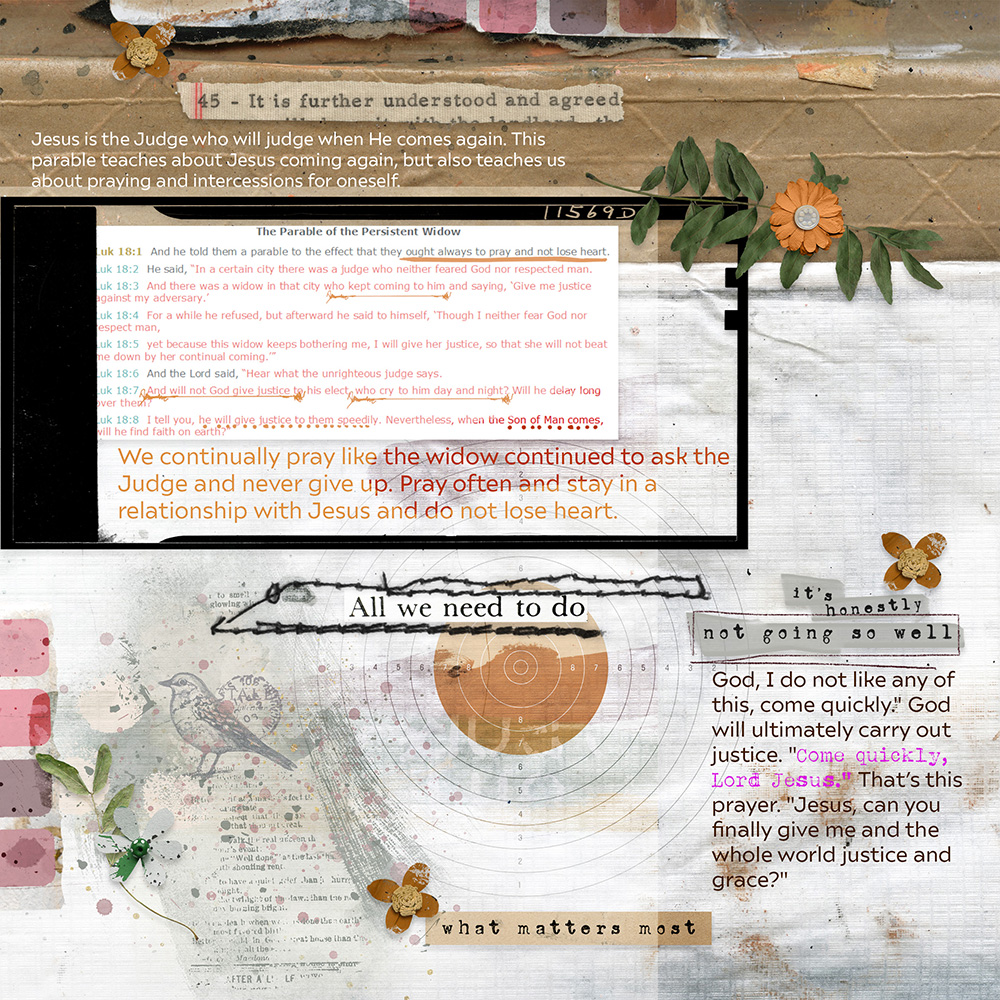
At the end of Chapter 17, Jesus tells us about the coming of His Kingdom, that He is already here, and about when He comes again. The He continues with this parable to help the disciples understand, and so that they will pray and not lose heart. Jesus is comforting them after giving them such scary news that He will be going away and coming back, and that loved ones will be left behind.
Jesus tells the disciples this parable, paraphrased. A judge did not fear God or respect man. Therefore, the judge was ungodly, but we still submit to the authority. A widow in the same city came to the judge and asked him for justice against her foe. The widow has no power to do it herself and stays in a relationship with the judge continually asking. Because the widow kept bothering him, even though he did not fear God or respect man, the judge gave her justice to shut her up.
Jesus continues, telling the disciples to pay attention to and hear what the unrighteous judge says because the judge responds to cries of help speedily. All the same aka nevertheless, when Jesus comes again, He will find faith on the earth, and it is that faith in Jesus who speedily gives justice that will happen when Jesus comes again.
This judge gave her what she wanted reluctantly. This parable does not say Jesus also answers us reluctantly because we are annoying and begging. Jesus is not like the unjust judge, but rather very much unlike him as Jesus cares and loves us.
Jesus is the Judge who will judge when He comes again. This parable teaches about Jesus coming again, but also teaches us about praying and intercessions for oneself.
We continually pray like the widow continued to ask the Judge and never give up. Pray often and stay in a relationship with Jesus and do not lose heart. 1 Thessalonians 5:17 tells us to pray without ceasing. Communication is key in all relationships. It's easy to loose heart when praying, but it helps to remember that the devil does not like prayer, so go ahead and cause him anger!
I have no control over justice and need to remember that when I feel like I can fix things. Instead, I should talk to the one who does have power of justice.
Does this mean that if I pray more God must give me want I want? Oh no! If God doesn't do what I ask Him, does that mean he doesn't care? Oh no! So false! Instead it shows who God is and that He does care. I can pray to express lament. "God, I do not like any of this, come quickly." God will ultimately carry out justice. "Come quickly, Lord Jesus." That’s this prayer. "Jesus, can you finally give me and the whole world justice and grace?"
CATECHISM: on the Lord’s prayer: How should we pray? Jesus told them a parable to the effect that they ought always to pray and not lose heart. Also, how does God answer prayer?
Luke 18:9-14 THE PHARISEE AND THE TAX COLLECTOR

Jesus tells a second parable about His coming again, this time to people who trusted in themselves thinking they were righteous enough while treating others with contempt. We should never give ourselves credit for having done good or right. I am only right and without sin because of Jesus who died on the cross for me and He does it all, and I do nothing. Sure, I should try to do right as part of the sanctification process of recognizing my sin and turning from it, but God gets the credit for that. Thy Will be done. Not my will be done!
The parable paraphrased is that a Pharisee and a tax collector go to the temple to pray. The Pharisee prayed thanking God that he is not like the others who sin, listing them and including the tax collector who is far off in the same room. The Pharisee lists the good that he does, including fasting and tithing, as if he can earn his way to heaven by doing good works. This Pharisee was comparing himself to other men and admitting it to God! He sure did have a high opinion of himself. There is no humbleness here. I should always have it in my heart that others are better than me. That's because they are!
The tax collector prayed and did not even lift his eyes to look to heaven. He felt he did not deserve heaven, and hit his chest while begging God to be merciful, declaring himself a sinner. "God, be merciful to me, a sinner!" is in our liturgy and are worthy words to pray. The tax collector relied on God and the Pharisee relied on himself.
Jesus says that the tax collector left being justified, but the Pharisee did not. Jesus says some well-known scripture here, "For everyone who exalts himself will be humbled, but the one who humbles himself will be exalted." The tax collector was justified immediately. The Pharisee thought his religious life and being good was reason to exalt himself, but the tax collector knew only God could exalt him.
As a reminder, this parable follows Chapter 17 about Jesus coming again. I am reminded that Jesus is the Judge who will judge all when He comes again. This parable is about Jesus justifying me by what He did on the cross and me responding by praying humbling recognizing my sins.
CATECHISM The Ten Commandments. 1st. You shall have no other gods before me. What does it mean to fear, love, and trust in God above all things? It means we look to God first and foremost for our well-being rather than to human goodness or religious devotion.