Job 8:19 The Not Good Kind of Joy
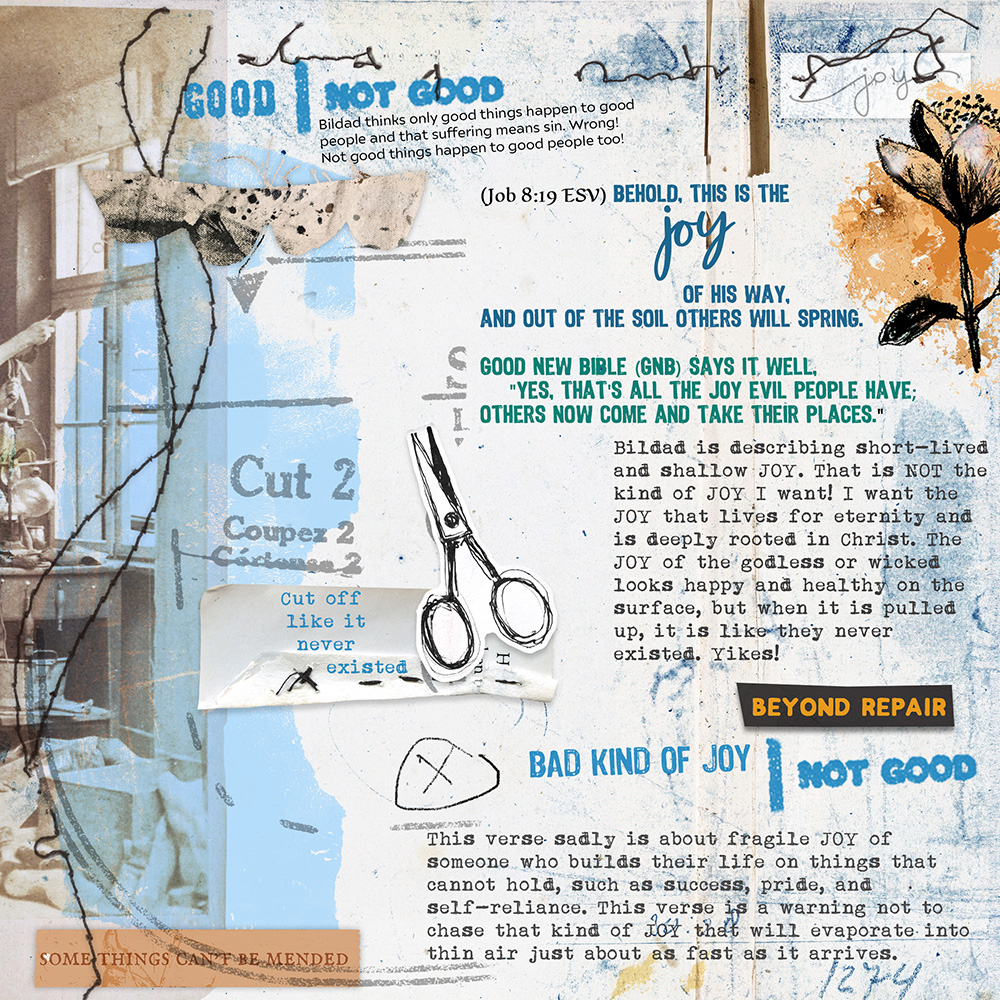
(Job 8:19 ESV) Behold, this is the joy of his way, and out of the soil others will spring.
(Joy Writing Challenge #30, July 20, 2026)
In the Book of Job, his three friends speak to explain and debate Job's sufferings, that being Eliphaz, Bildad, and Zophar. In Chapter 8, Bildad is speaking. He also speaks in Chapter 18 and 25.
In his first speech, Bildad argues that Job's suffering must be because of sin, defending God's justice, and urging Job to repent so God will restore him. Bildad insists that God is always fair and never does anything wrong.
Bildad concludes that Job's children must have died by their own wrongdoing. If his children did something bad, they suffered their own consequences. So likewise if Job has done something wrong, he should talk to God and admit his wrongs and ask for forgiveness.
Bildad insists that the history of past generations confirm that God rewards the righteous and punishes the wicked. If Job lives the right way, God will make his life good again.
Oh, how wrong Bildad is in his arguments! Job did nothing wrong, and he lived in the right way, and yet he suffered for no reason to do with his own actions. Bildad thinks only good things happen to good people and that suffering means sin. Wrong! Not good things happen to good people too!
Bildad uses a metaphors that (1) like papyrus without soils, (2) like reeds without water, (3) like a flower that withers before others, (4) like a spider's fragile web, (5) like a house that falls when leaned upon, (6) like a lush plant invading the garden and house that is destroyed by the gardener who says he has never seen it as if it never existed, to describe what the godless people look like. Godless people may look strong for a while, but they do not last.
In verse 19 of Chapter 8, the JOY is different that our previous studies of the word in that it is used negatively. ESV "Behold, this is the JOY of his way, and out of the soil others will spring." This is difficult to understand because it needs to be read in context to know who the "his" is in the verse. I like how the Good New Bible (GNB) puts it, "Yes, that's all the JOY evil people have; others now come and take their places."
Bildad is describing short-lived and shallow JOY. That is NOT the kind of JOY I want! I want the JOY that lives for eternity and is deeply rooted in Christ. The JOY of the godless or wicked looks happy and healthy on the surface, but when it is pulled up, it is like they never existed. Yikes! Such flimsy JOY!
I love garden analogies and I can relate to times when I have waited a long time for a flower to bloom, caring for it every day in anticipation, and then it finally blooms, and the heat of the summer comes out, or an invasion of nasty bugs begins to chomp on the plant, and just like that, overnight, before I can save it, it is gone. I wake up in the morning and it is no more. The flower has disappeared without leaving a trace. Now I am standing there mourning its loss, but in this Bible story, the plant is not missed at all. The flower in my analogy is the little bit of short-lived joy described in this verse.
It makes me recall that some flowers do bring me SO much JOY all bright, surprising, cheerful and successful, but they only last a day or even an afternoon as they close up when darkness falls. There are those flowers and then there are the flower that can be cut and last in a vase for weeks.
This verse sadly is about fragile JOY of someone who builds their life on things that cannot hold, such as success, pride, and self-reliance. This verse is a warning not to chase that kind of JOY that will evaporate into thin air just about as fast as it arrives.
H4885 masows; Pronounced mah-SOCE or maw-soce; exultation, joy, rejoicing; the cause or object, or feeling, of delight Uses: joy (12x), mirth (3x), rejoice (2x).