Job 29:13 Causing Another's Joy
Joy Challenge #33; August 20, 2026
(Job 29:13 ESV) The blessing of him who was about to perish came upon me, and I caused the widow's heart to sing for joy.
Job is suffering through a big case of "if only's." If only my life was like it was before! If only! Job is longing for life to be as it was before. I get those feelings too. I wanted to keep going through the generations the good things of my youth which I enjoyed. What I imagined my life would be like is nothing like I wanted it to be and there is no way I can make it be that way. I have no control. Other people seem to have more control of my life than I do. I often say, "I wake up happy every day, until other people change it for me."
Job is falsely equating the good things of the past as a reward for friendship of God. Job recalls good things such his family, his plentiful butter and oil, the respect of others, honor as a leader, the ability to help the poor, orphaned, widowed, and the suffering, and to keep his community safe from enemies. Job is not boasting, but rather lamenting the loss of the good life that is now gone.
Everything was going so good that Job expected a long and fruitful life under God's blessings, and then of none of his own doing, all that he had was gone. He feels all of God's blessings have left him. "What a friend we have in Jesus," does not equate to prosperity and earthly blessings. Job's incorrect thinking caused him to have a false sense of security.
Job is reflecting on a time when he was able to lift others up who were suffering, and now the roles are reversed and he is suffering and in need of help. Job not only was stripped of his wealth that gave him a source of JOY for others, but he is now weeping alone himself.
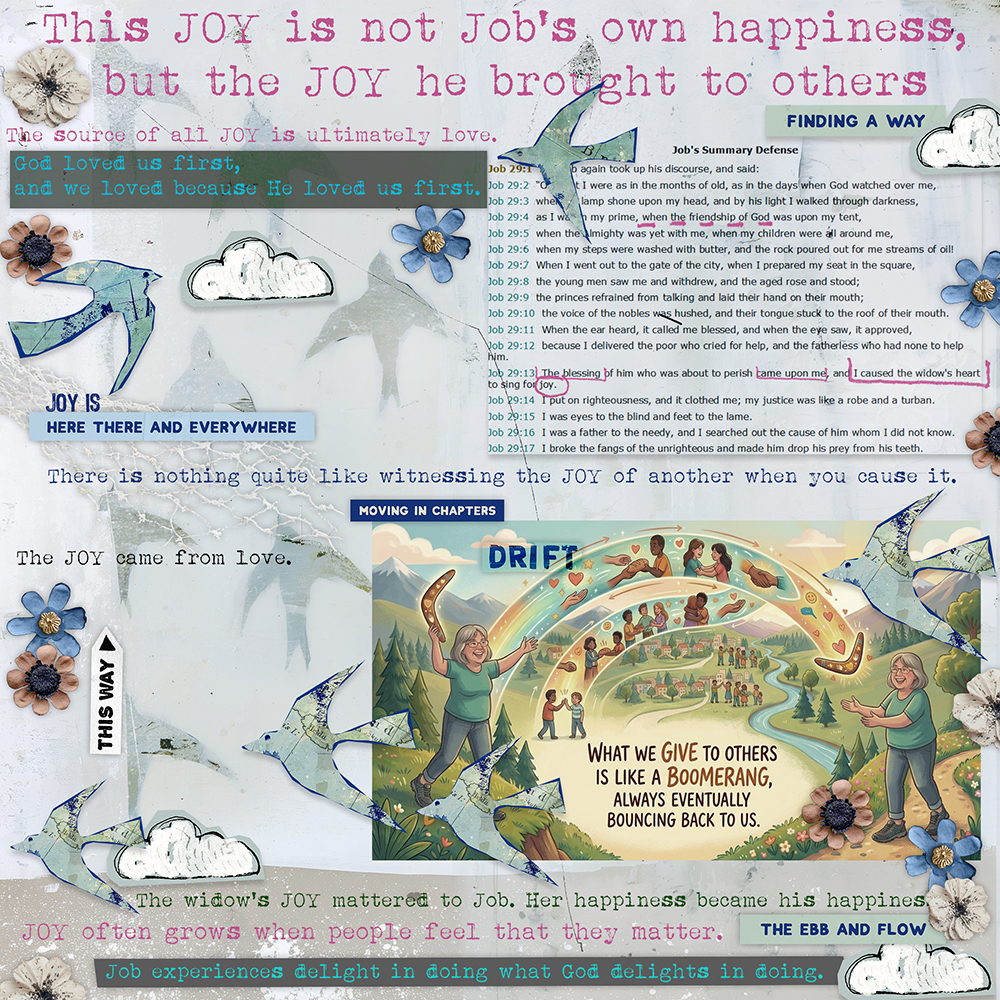
The above summarizes the chapter and the context, but my challenge is to consider the JOY in verse 13. This JOY is not Job's own happiness, but the JOY he brought to others, that being a perishing person and a widow.
I ponder how desperate a person must be to consider oneself about the perish, and how it would feel to have that state of being in complete reversal. How shocked and speechless I might be if I were on the brink of death and then suddenly not! Job was blessed to give that complete reversal to someone else! Now that is a JOYful blessing!
I ponder the widow who in Bible times, who without a male, having no means to care for herself, was constantly vulnerable to starvation and debt. When she was helped by Job, her heart was moved from constant fear and survival anxiety to JOYful singing! The widow felt a heavy weight lifted off her which allowed her heart to expand and breathe again. Doubt was transferred into hope! Her JOY (ranan) was so uncontainable that it surged up from her core and spilled over into spontaneous song.
I make special note of the words, "I caused." This tells me that one JOY gave birth to another JOY. I have written before to share how what we give to others is like a boomerang, always eventually bouncing back to us. Here Job causes the widow to have JOY, and seeing her heartfelt and overflowing JOY causes Job to feel the JOY of love, generosity, compassion, and selflessness.
I can relate to the anticipatory JOY as Job quietly and purposefully gives from his heart. A giver anticipates the loud and bursting JOY of the receiver. There is nothing quite like witnessing the JOY of another when you cause it. JOY is so contagious in that a giver cannot hold back a smile at the sight of causing someone else's happiness. The widow's JOY mattered to Job. Her happiness became his happiness.
I consider where the JOY actually came from, that being from God. Job helped the perishing person and the widow through love and compassion. 1 John 4:19, "We love because he first loved us."
Job's helping hand was aligned with God's heart. Psalm 68:5, "Father of the fatherless and protector of widows is God in his holy habitation." Job's joy arose from giving mercy. God used Job's hands to deliver goodness to another.
God has compassion on His children. Compassion is feeling what another feels and the heart responds in action. Job's heart felt the crushing weight being lifted off of the widow's shoulders as he helped her, and her relief was also felt in the heart by him. Job experiences delight in doing what God delights in doing.
When God's children are hurting, He cares. When God's children are helped, comforted, and filled with JOY, God delights, just like a loving father who loves to see his children smile. The JOY came from love. The widow felt loved, and Job loved seeing her happy. Job's JOY comes from making someone else's day bright and safe.
The boomerang JOY felt by Job reflects how God Himself delights in delivering goodness to His children. God delights in blessing others, restoring what is broken, and bringing hope where there was once despair. Throughout Scripture, God rescues those who are suffering, and ultimately, He rescues all people suffering under the weight of their sin through Jesus's death on the cross. The source of all JOY is ultimately love. God loved us first, and we loved because He loved us first.
The widow's JOY was in receiving help and hope. Job's JOY was in giving help and seeing another restored. God's JOY is in delighting in righteousness and compassion of those He loves.
H7442 רָנַן rânan, pronounced raw-nan', to creak (or emit a stridulous sound), i.e. to shout (usually for joy): aloud for joy, cry out, be joyful (greatly, make to) rejoice, (cause to) shout (for joy), (cause to) sing (aloud, for joy, out), triumph.
JOY often grows when people feel that they matter. When you help someone feel important, valued, safe, and loved, their heart can begin to "sing for joy," just like the widow's heart. Something beautiful happens when their JOY gives you JOY. God made us to share JOY with one another.
I consider ways that I can be like Job by helping someone feel JOY by making them feel seen, loved, and cared for.
Talk with someone who feels left out.
Sit with a lonely person.
Give a hug when someone is sad.
Say, "I'm glad you're here."
Help someone who is struggling.
Listen without interrupting.
Encourage someone who feels discouraged.
Help with a practical need.
Forgive someone.